
Why this is worth planning early
Travellers with mobility needs learn quickly that the difference between a good trip and a difficult one is rarely attitude. It is detail: a step height nobody mentioned, a vehicle that turned out to be higher off the ground than expected, a drop-off point a hundred metres further from the entrance than the website implied. None of these are dramatic on their own, and all of them are much easier to sort out weeks ahead than on the day. This is a guide to the questions worth asking, whoever you end up booking with.
Be specific about what you actually need
Accessibility is not one requirement, and providers cannot plan around a general request. A traveller who walks short distances but cannot manage a high step needs something quite different from a traveller using a manual wheelchair, who in turn needs something different from a traveller with a powered chair. Powered chairs in particular have weight and dimension implications that determine whether a given vehicle is viable at all. The more precisely you describe the situation when booking, the more likely the answer you get is accurate rather than optimistic.
The question about vehicle height
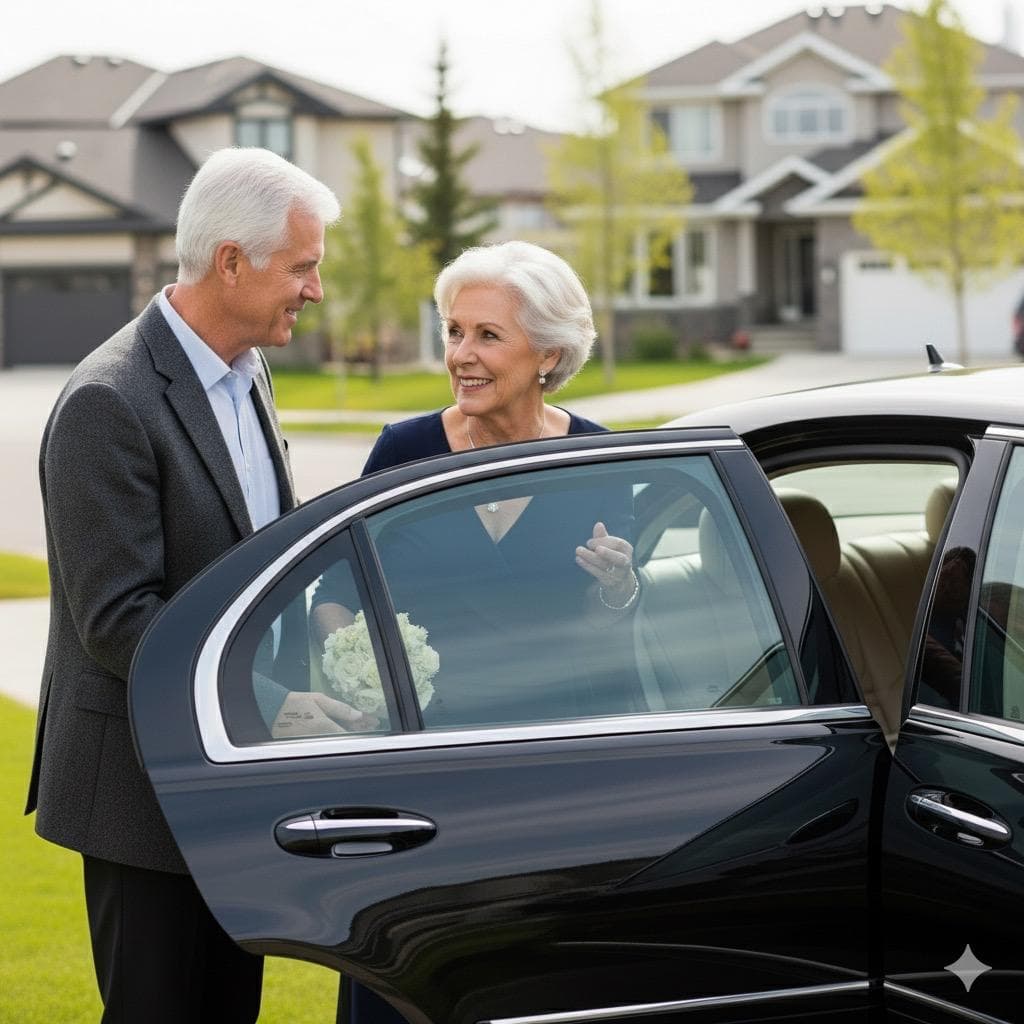
This one comes up constantly and is easy to overlook. Full-size SUVs sit noticeably higher off the ground than sedans, which is an advantage for some travellers and a genuine obstacle for others. If stepping up is difficult, a lower vehicle may suit you better even though it is smaller. If you need to transfer from a chair to a seat, the relative heights of the two matter a great deal. It is a reasonable thing to ask about directly, and any competent operator should be able to tell you.
Mobility equipment and luggage together
A folding wheelchair, walker or rollator takes up cargo space that is then unavailable for suitcases. It sounds obvious written down, and it is still one of the most common planning oversights, particularly for groups. If you are travelling as a family or with companions, work out the full picture: how many passengers, how many bags, and what equipment. PrimeKar's Elite XL class uses full-size SUVs and takes up to 6 passengers, which generally offers more cargo room than the 4-passenger Executive class. Describe what you are bringing when you book so the vehicle is matched to it rather than assumed.
What we can and cannot do, stated plainly
PrimeKar operates standard passenger sedans and SUVs. We do not operate wheelchair-accessible vehicles with ramps or lifts, so a traveller who must remain in their wheelchair throughout the journey needs a specialist accessible transport provider rather than us. For travellers who can transfer to a standard vehicle seat, and whose mobility equipment folds and stows, we can generally help, and drivers assist with luggage and equipment as a matter of course. We would rather tell you that clearly at the planning stage than have you discover it at the curb.
Arriving at YYC
Calgary International Airport publishes accessibility information covering assistance services, accessible washrooms, and mobility support through the terminal. If you need assistance between the aircraft and the arrivals area, that is arranged through your airline in advance rather than on arrival. Worth knowing when planning ground transportation: airline-arranged assistance can add time to your journey through the terminal, so a pickup arranged for the scheduled landing time may be optimistic. For inbound YYC flights PrimeKar tracks the arrival, and airport transfers include complimentary wait time, which exists for exactly this kind of variability.
Distances in the mountains are longer than they look
Banff, Canmore and Lake Louise are mountain destinations, and the terrain is not flat. Car parks sit further from viewpoints than photographs suggest, paths have gradients that maps do not show, and surfaces vary from paved to loose gravel within a single short walk. Parks Canada publishes accessibility information for specific sites and trails, and it is worth reading for the particular places you plan to visit rather than assuming a general standard applies across the parks. Some locations are genuinely well provisioned; others are not.
The Moraine Lake access change
Private vehicle access to Moraine Lake has been removed, and visitors now arrive by Parks Canada shuttle, commercial operator, or booked transportation. For travellers with mobility needs this changes the planning materially, because it introduces a transfer between vehicles that did not previously exist. If Moraine Lake matters to your trip, check the current access arrangements and the accessibility of the shuttle option directly with Parks Canada while you are still planning.
Build in more time than the itinerary suggests
Almost every part of a journey takes longer when mobility is a factor: getting through the terminal, loading, transferring, and covering ground at the destination. A schedule built on standard timings will feel rushed, and rushing is where accessible travel tends to go wrong. Plan fewer things per day than you think you can manage, and put real margin around anything with a fixed time attached, particularly a departing flight.
A short list of questions to ask any provider
What vehicle will actually arrive, and how high is the step into it? Can the driver assist with transfers, and what are the limits of that assistance? Where exactly will the pickup and drop-off happen, and how far is that from the entrance? Can mobility equipment be stowed alongside our luggage? What happens if our flight is delayed? Ask these of anyone you are considering, including us. A provider who answers precisely is telling you something useful; one who answers vaguely is telling you something too.