
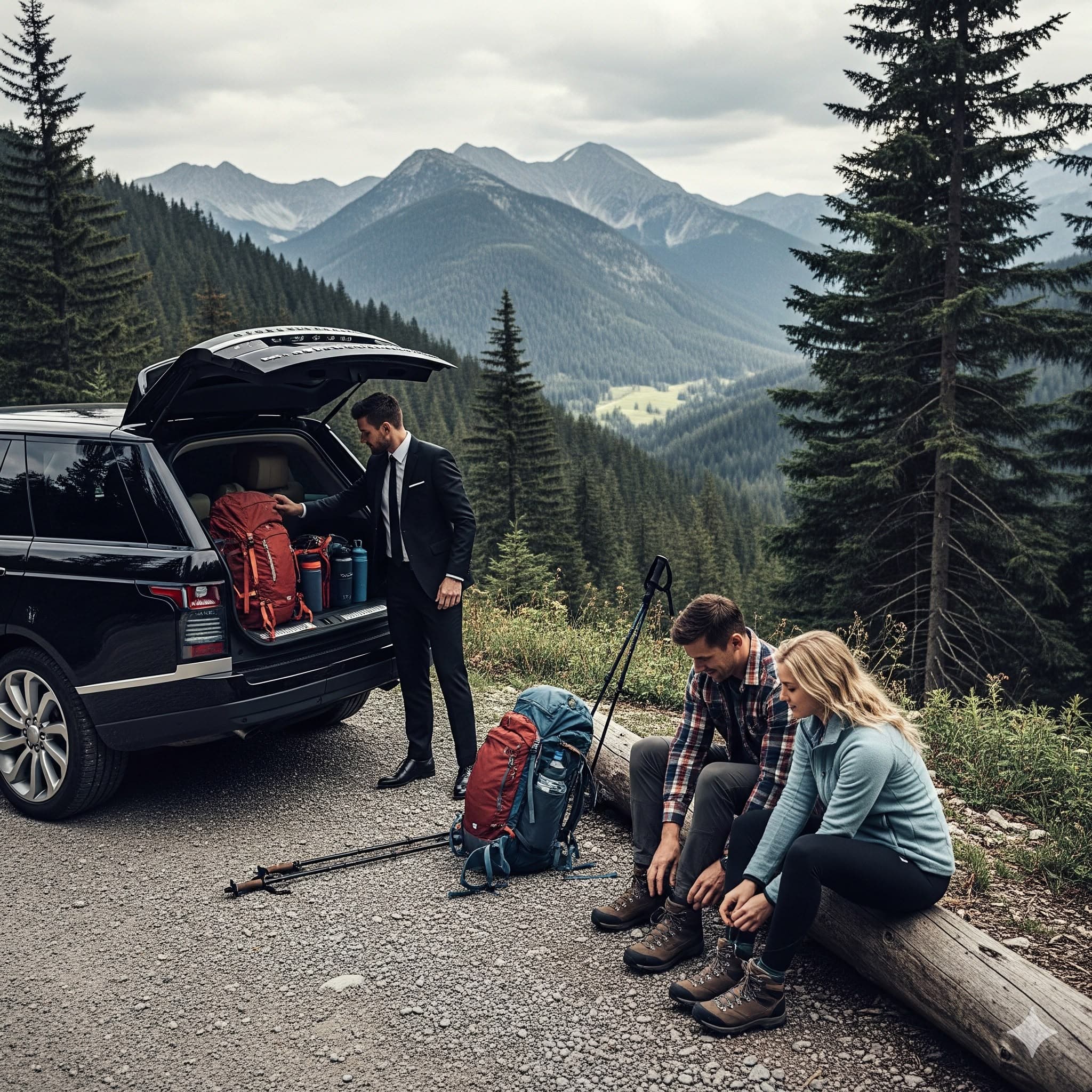
How far is it, really?
The drive from Calgary to Banff is about 128 kilometres on the Trans-Canada Highway, and in normal conditions it takes around ninety minutes. That makes it the second-shortest of PrimeKar's four mountain routes, with only Canmore closer, and it is genuinely a day trip rather than an overnight commitment. The ninety-minute figure is a fair average for good conditions. In winter, on a long weekend, or during the summer peak, treat it as a starting point rather than a promise, and plan the day with margin rather than assuming the best case.
What the drive looks like
The highway climbs steadily west out of Calgary, and the Rockies stop being a distant skyline well before you reach the park gates. You pass Canmore and the Three Sisters peaks on the way in, then cross into Banff National Park itself, with the townsite sitting at the base of Cascade Mountain on the Bow River. It is a wide, well-maintained divided highway for the entire stretch, and unlike many mountain approaches there is no slow, winding section to account for. The scenery does most of its work in the second half.
Building the day backwards
The most reliable way to plan a Banff day trip is to start from when you need to be back in Calgary and work backwards, rather than starting from when you want to leave. Ninety minutes each way is three hours of driving before you have done anything at all. Add a Parks Canada gate stop, parking, lunch, and whatever you actually came to see, and a day that felt generous at the planning stage gets tight quickly. Most people who come back disappointed tried to fit three destinations into one day.
Leave earlier than feels reasonable
This is the single most repeated piece of advice from people who do the route often, and it is worth taking seriously. An early departure means arriving before the day's traffic and before the car parks fill, and in summer the difference between arriving at eight and arriving at eleven is substantial. It also gives you slack. A day trip that starts early can absorb a delay, a longer lunch or a change of plan; one that starts at ten cannot absorb anything at all.
Parking in the townsite is the real constraint
Banff townsite is small and the demand on it is not. In peak season, parking is genuinely difficult, and the time spent circling for a space is time removed from the reason you came. This is one of the quieter arguments for being dropped off rather than driving yourself: a drop-off at the point you actually want to be removes the parking problem entirely. If you are driving, look into the parkade and the shuttle arrangements before you go rather than after you arrive.
The Lake Louise and Moraine Lake question
A lot of people plan a Banff day trip and then add Lake Louise, or assume Moraine Lake is a short detour. Both deserve their own consideration. Lake Louise is a further 55 kilometres or so beyond Banff, which adds meaningfully to an already full day. Moraine Lake is more significant still: private vehicle access has been removed, and visitors reach it by Parks Canada shuttle, commercial operator or booked transportation. If either lake is the actual point of your trip, check the current access arrangements with Parks Canada at the planning stage, because they change what a realistic day looks like.
A straight transfer or a fuller day
If you are going in, spending the day, and returning on a schedule you already know, that is a straightforward point-to-point transfer in each direction. If the plan has several stops, an uncertain return, or sightseeing built into the journey itself, it is better arranged as a custom trip from the outset. Describing the shape of the day up front is more useful than trying to fit an improvised itinerary into a structure that was not built for it. One thing to be clear about: hourly, as-directed service is a local Calgary arrangement, so a mountain day is handled as a route transfer or a custom quote rather than by the hour.
Practical things worth knowing
A Parks Canada entry fee applies once you cross into Banff National Park, and it is separate from the cost of transportation. Cell coverage is generally reliable along the highway but thins in short patches through the park, so download anything you will need rather than relying on a signal. Wildlife does cross the highway, particularly around dawn and dusk, which is part of why trips at either end of the day are driven at a measured pace. And mountain weather can differ substantially from Calgary weather on the same afternoon, so bring a layer more than the forecast suggests.
Seasons change the trip more than the distance does
The same 128 kilometres is a different day in February than in July. Summer brings long daylight, full car parks and peak crowds. Winter brings short daylight, quieter townsite streets, and conditions that require more time and more flexibility. Late December offers roughly eight hours of useful light in the Bow Valley, and the mountains bring dusk earlier still. If the point of the trip is scenery, plan around the available light rather than around the clock.
Coming back
The return leg, Banff to Calgary, books the same way as the trip out, as its own point-to-point transfer timed for when you actually want to leave. If you are flying out the same day, that includes drops at YYC, and it is worth being conservative with the timing. A late afternoon departure from Banff on a Sunday in summer is not the same drive as a Tuesday morning in October, and a flight is an unforgiving thing to plan tightly around.